
From Icebox to a sprint-ready backlog

Giving Magnetic’s design team a clearer way to understand work, plan it, and keep ownership with the people doing it.
- DPM & DesignOps

- Cisco – Jun 2026 to Sept 2026

The starting point
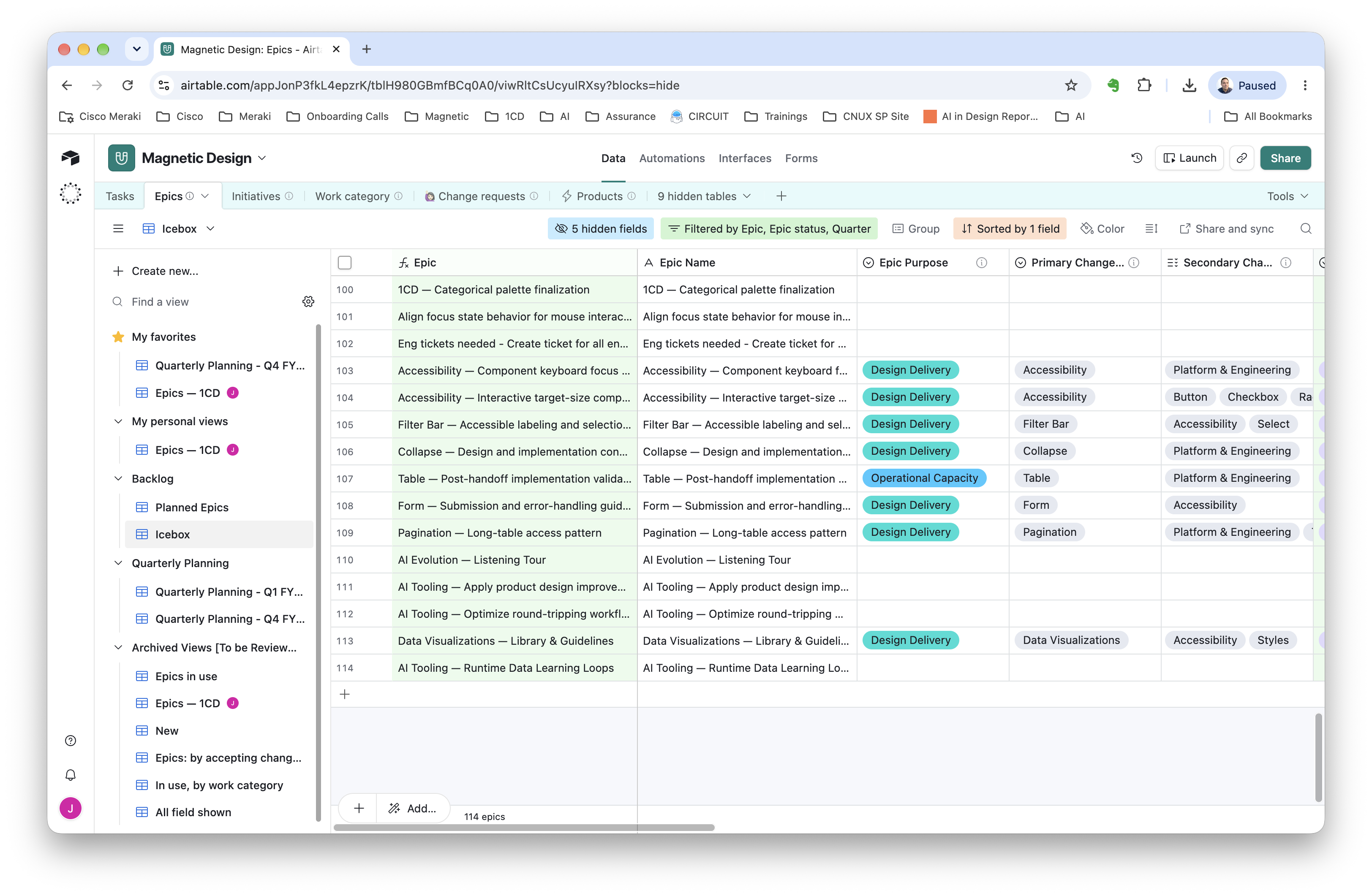
Magnetic’s Icebox had become a useful place to capture almost everything: design delivery, documentation, support, engineering coordination, and older requests. But capturing work and being ready to plan it are different things.
I developed a backlog-readiness approach that connected a one-time cleanup with an ongoing sprint model. I also created the Magnetic Backlog Review Codex skill to help designers apply the same review logic without handing decision-making over to automation.
My contribution
I led
The operational approach, workflow guidance, facilitation materials, and calibration of the backlog-review process.
I partnered
With design leadership on planning rules and exceptions, and with designers and Epic owners on scope, ownership, and approval.
I worked hands-on
On the backlog model, Airtable guidance, review paths, and Codex skill. Designers retained responsibility for validating recommendations and applying approved changes.
The challenge
Make planning a decision, not a cleanup session
A broad item might be a single task, a larger outcome, a duplicate, or work waiting on engineering. Without a consistent way to tell them apart, even simple planning conversations needed interpretation.
The design decision was to separate readiness from commitment. Cleanup would clarify the work; sprint planning would decide what to take on.
The approach
Separate the reset from the ongoing rhythm
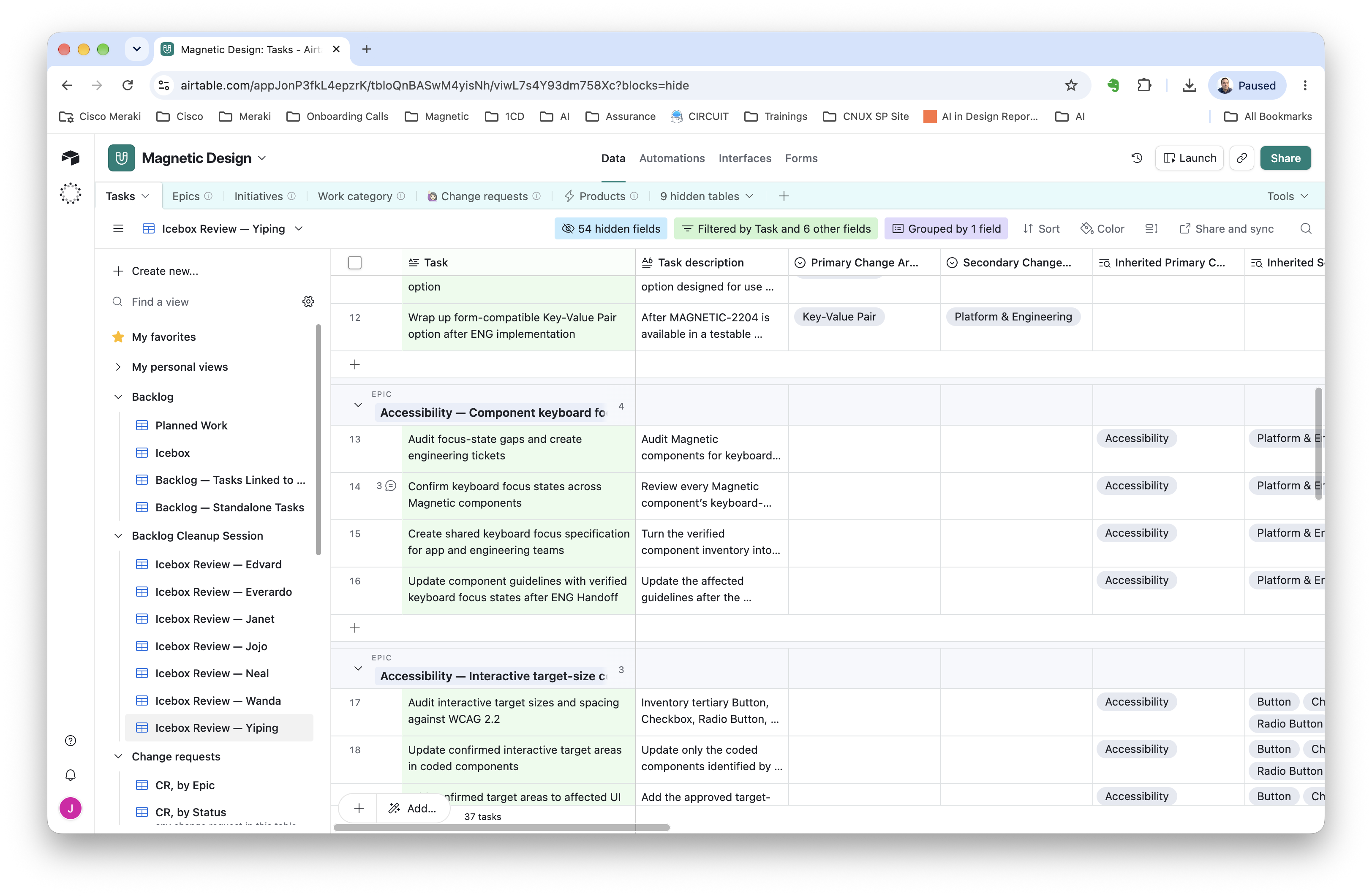
The one-time review checks whether each task is relevant, clearly scoped, and correctly placed. Sprint assignments, estimates, and reserved capacity come later, when the team makes planning decisions.
01 · Clarify
Describe a specific action and its scope.
02 · Place
Connect to a suitable Epic, keep standalone, or request triage.
03 · Commit
Select and estimate work during sprint planning.
Use containers only when they help
Epics represent outcomes with multiple tasks or follow-up—not broad permanent buckets. A clear standalone task can remain standalone. Change Areas describe the part of Magnetic affected without forcing every task into an unnecessary Epic.
Keep handoff and follow-up distinct
Completed design work stays Done. A separate follow-up task captures a known design outcome after engineering handoff, preserving the distinction between delivered design scope and remaining work.
The Codex skill
A consistent first pass, with human control
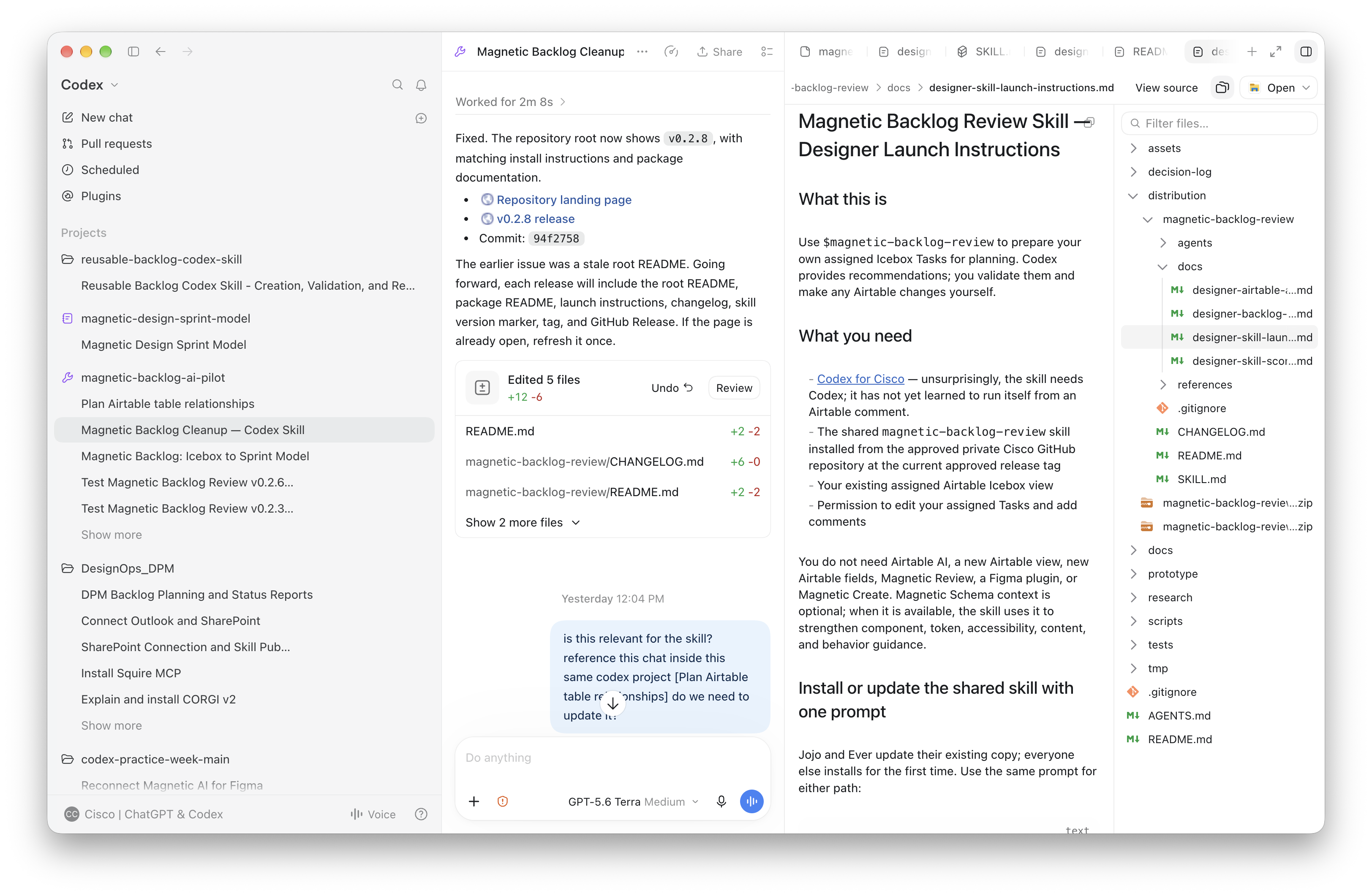
Magnetic Backlog Review v0.2.8 accepts a pasted task or filtered CSV and recommends a cleanup path, clearer naming, relationships, and manual Airtable actions. It identifies questions that need judgment.
01 · Review evidence
The skill reads the supplied task and references.
02 · Recommend
It proposes a path and explains open questions.
03 · Decide
The designer validates; the appropriate owner approves.
04 · Apply
The designer makes approved updates in Airtable.
I kept a manual review path available. The skill supports the operating model; using Codex is not a prerequisite for participating.
Pilot learning
Keep the planning benefit; reduce the burden
The 1CD retrospective supported more intentional planning and better individual visibility. It also surfaced confusing work relationships, too many Airtable views, and excessive administrative effort.
That feedback informed the direction toward clearer tasks and lighter upkeep. It validates the need and parts of the planning approach—not a measured efficiency gain or full rollout of the final backlog model.
What took shape
The work produced a documented cleanup model, five review paths, handoff guidance, human approval rules, and a reusable Codex skill. The intended result is a backlog the team can understand and plan from more consistently; completion and adoption of the full model remain separate milestones.
How I would measure progress
Proposed measures for the ongoing backlog work. Establish a baseline and agree targets with the team before reporting improvement.
Backlog readiness
Reviewed active tasks meeting agreed scope, ownership, and placement criteria ÷ reviewed active tasks. Leadership sees how much work is ready for planning.
Review effort
Median designer review time per task, measured separately for manual and Codex-assisted review, alongside correction rate. Shows whether the skill saves useful effort.
Sprint carryover
Committed tasks carried into the next sprint ÷ tasks committed at planning; track scope changes separately. Shows planning and dependency friction.
Recommendation acceptance
Skill recommendations accepted without substantive correction ÷ reviewed recommendations. Shows reliability and where human calibration is needed.
What I carry forward
Design the process for the people using it
A useful operating model makes the next decision easier. The lesson from the pilot was to preserve visibility while removing unnecessary upkeep—and to make automation a source of suggestions, not silent changes to the team’s work.
